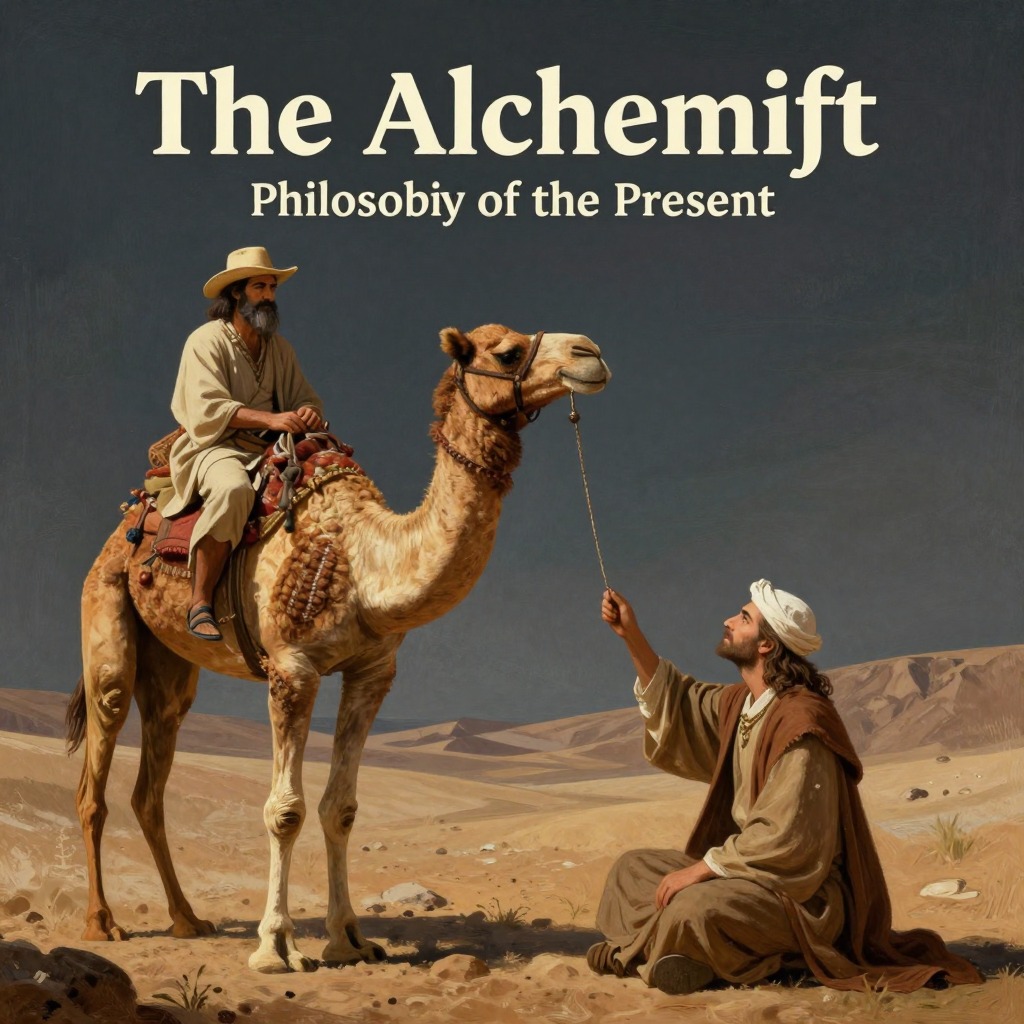
El Cairum
El Cairum is a village in the Egyptian countryside, mentioned only once in the narrative but carrying decisive weight as the former home of the camel driver who travels alongside Santiago during the caravan crossing of the Sahara. The camel driver recounts his life there in a single, concentrated speech one night around the fire, and that recollection gives El Cairum its entire significance in the story: it is the place where a settled man lost everything and, through that loss, learned the lesson that makes him a guide not only across the desert but toward an understanding of fate.
The Camel Driver's Former Life
The camel driver tells Santiago that he "used to live near El Cairum," where he owned an orchard, raised children, and expected a life that would "change not at all until I died." In the year when the crop was the best ever, he and his family made the pilgrimage to Mecca, satisfying the fifth obligation of every Muslim—a journey he believed would allow him to die happily. The village thus represents a completed, self-contained existence: a man who had fulfilled his religious duty, enjoyed prosperity, and anticipated no further disruption.
The Disaster and Its Aftermath
That settled world collapsed when "the earth began to tremble, and the Nile overflowed its banks." The camel driver had thought such a catastrophe "could happen only to others, never to me." His neighbors feared losing their olive trees; his wife feared for their children. The land was ruined, and he was forced to find another way to earn a living. The disaster at El Cairum transformed him from a farmer into a camel driver, a profession that keeps him perpetually in motion across the desert he had never needed to cross before. The loss, however, taught him a principle he later passes to Santiago: "people need not fear the unknown if they are capable of achieving what they need and want." He adds that "this fear evaporates when we understand that our life stories and the history of the world were written by the same hand."
Narrative Significance
El Cairum appears only in the camel driver's retrospective account, yet it functions as a crucial counterpoint to the settled lives Santiago encounters elsewhere—the crystal merchant who has spent thirty years in the same shop, the baker who chose security over travel, and the tribal chieftains rooted in their oasis traditions. Unlike those figures, the camel driver was forced out of his rooted life by an external calamity, and that forced departure became the condition for his wisdom. He is the only character in the book who has lived both a completely stationary life and a completely nomadic one, and El Cairum is the hinge between those two states. The village also echoes the novel's broader geography of loss and transformation: just as the desert was once a sea, El Cairum was once a fertile orchard, and both have been remade by forces beyond human control. The camel driver's story from El Cairum gives concrete, local weight to the abstract principle that "Maktub"—it is written—and that the same hand that writes destruction also writes the path forward.